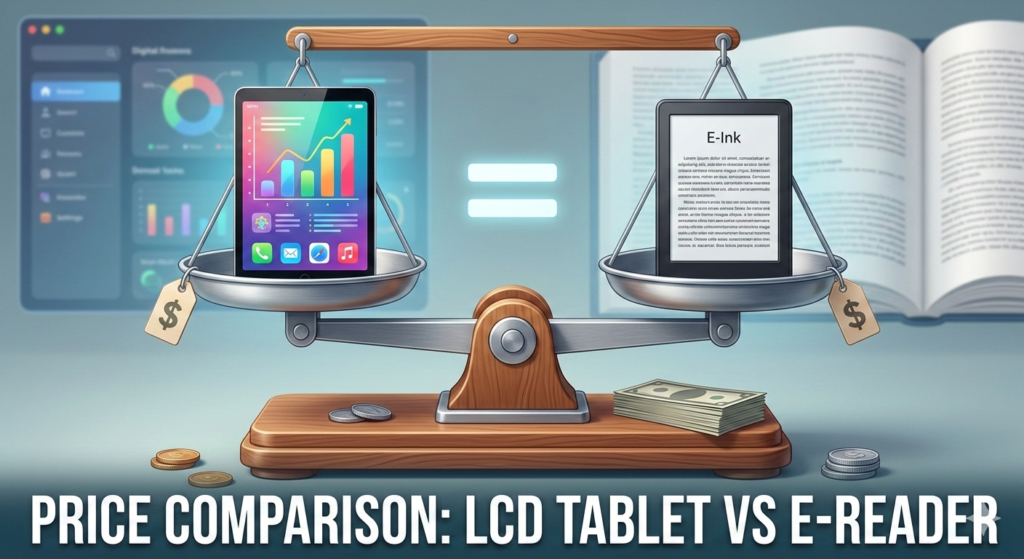
It is a common scenario: a consumer decides to buy a digital note-taking tablet to replace their paper notebook. They search for "E-Ink tablet" and are immediately shocked by the price tag. A device with a monochrome screen, a slower processor, and no ability to play video often costs as much—or more—than a standard iPad or Android tablet.
This price discrepancy seems counterintuitive. How can "old" technology (black and white screens) cost more than cutting-edge OLED displays? The answer is a mix of economics, physics, and intellectual property. In this market analysis, we will break down why is e-ink expensive and explore the hidden costs behind electronic paper.
The Core Reasons: Patents, Physics, and Scale
If you are looking for the short answer, here it is:
E-Ink technology remains expensive primarily due to the complex manufacturing of electrophoretic microcapsules, limited economies of scale compared to LCD screens, and the dominant market position of E Ink Holdings, which supplies the vast majority of commercial electrophoretic display film.
1. The Monopoly on "Magic Paper"
Unlike LCD technology, which is manufactured by dozens of competing companies (Samsung, LG, BOE, etc.), the electronic paper market is effectively a single-supplier market for commercial electrophoretic displays.
Almost all e-readers, from the Amazon Kindle to the reMarkable tablet, use film manufactured by one company: E Ink Holdings based in Taiwan. While the devices are made by different brands, the screen technology itself comes from the same source. Without fierce competition to drive down manufacturing costs, the price of the raw material remains high. Although alternative electronic paper technologies exist, none currently match E Ink Holdings’ manufacturing scale or commercial maturity.
2. Manufacturing Complexity
It is easy to assume that because the screen looks like low-tech paper, it must be cheap to make. However, as we detailed in our guide What is E-Ink Technology?, the technology is incredibly sophisticated.
An LCD screen is essentially a sandwich of glass and liquid crystals. An E-Ink screen is a suspension of millions of microscopic fluid-filled capsules containing charged particles.
- Precision: If the capsules are not perfectly uniform, the screen will look blotchy.
- Durability: The fluid must be sealed perfectly to prevent evaporation or leakage over a decade of use.
- Yield Rates: Creating a defect-free sheet of millions of microcapsules is difficult, leading to lower "yield rates" (more wasted product) compared to mature LCD lines.
Because these screens are delicate and costly to replace, protecting your investment with a sturdy Budget E-Reader Case is highly recommended, as a cracked screen usually totals the device.
3. Economies of Scale
The most significant factor in consumer electronics pricing is volume.
- LCD/OLED: Billions of screens are made every year for phones, TVs, monitors, smartwatches, and even refrigerators. This massive volume drives the cost per unit down to pennies.
- E-Ink: The market is limited primarily to e-readers, digital signage, and shelf labels. The volume is in the millions, not billions.
Because the factories are not churning out E-Ink panels at the same rate as smartphone screens, the fixed costs of running the factory must be spread over fewer units, keeping the price per unit high.
4. Niche Hardware Costs
It isn't just the screen that drives up the price; it is the rest of the computer inside the device.
- Custom Controllers: E-Ink requires specialized timing controllers (T-Cons) to manage the movement of particles. These aren't as off-the-shelf as standard display drivers.
- Battery Tech: While the screens save power, users expect weeks of life. This requires highly optimized, energy-efficient motherboards that are often custom-designed rather than mass-produced generic boards used in cheap Android tablets.
Will Prices Ever Drop?
The good news is that prices are stabilizing. As E-Ink technology expands into new markets—specifically Electronic Shelf Labels (ESL) in retail stores like Walmart and Best Buy—the production volume is skyrocketing.
This increased demand for small E-Ink screens is helping E Ink Holdings expand their production capacity, which slowly helps lower costs for the larger screens used in e-readers. However, until a viable competitor emerges with a different type of electronic paper technology, E-Ink devices will likely remain a premium product compared to budget LCD tablets.
Conclusion
The high price of E-Ink is a reflection of its specialized nature. You are paying for a unique optical property—bistability and sunlight readability—that no other tech can offer. While the lack of competition and lower production volumes keep prices high, the value lies in the device's ability to offer a distraction-free, eye-friendly reading experience that standard tablets simply cannot match.
Frequently Asked Questions (FAQ)
1. Are there any cheap alternatives to E-Ink?
There have been attempts, such as "Memory LCD" (used in Pebble watches) or "RLCD" (Reflective LCD), but none have matched the contrast and paper-like quality of genuine E-Ink. For now, E-Ink remains the gold standard.
2. Why are color E-Ink tablets even more expensive?
Color E-Ink (Kaleido or Gallery) adds another layer of complexity. It requires a Color Filter Array (CFA) to be perfectly aligned with the black and white capsules below. This precise alignment lowers manufacturing yields, driving up the cost significantly.
3. Is the E-Ink patent expiring soon?
Many of the original core patents from the 1990s have expired, which is why we are seeing some new developments. However, E Ink Holdings continuously files new patents for their latest improvements (like Carta 1200 and Kaleido 3), maintaining their grip on the high-end market.
4. Why is the Kindle cheaper than other E-Ink tablets?
Amazon often sells Kindles at or near cost (breaking even) because they make their money back when you buy books from the Kindle Store. Independent hardware makers like Onyx or Supernote do not sell books, so they must make their profit on the hardware itself, resulting in a higher upfront price.
5. Can I repair a broken E-Ink screen?
Technically yes, but practically no. The replacement E-Ink panel often costs nearly as much as a new device, and the lamination process makes DIY repair extremely difficult.