In a world dominated by glowing LED screens and vibrant OLED displays, E-Ink technology stands out by doing something radically different: it tries to be as boring as paper. For many users, the first time they see a modern e-reader, they assume there is a dummy sticker on the screen because the text looks so static and print-like.
However, behind that simple appearance lies complex engineering designed to reduce eye strain and maximize battery efficiency. If you have ever wondered what is e-ink technology and how it manages to display text without a backlight, you are not alone. This guide will explore the mechanics of electronic paper, its history, and the unique "bistable" nature that makes it unlike any other display tech on the market.
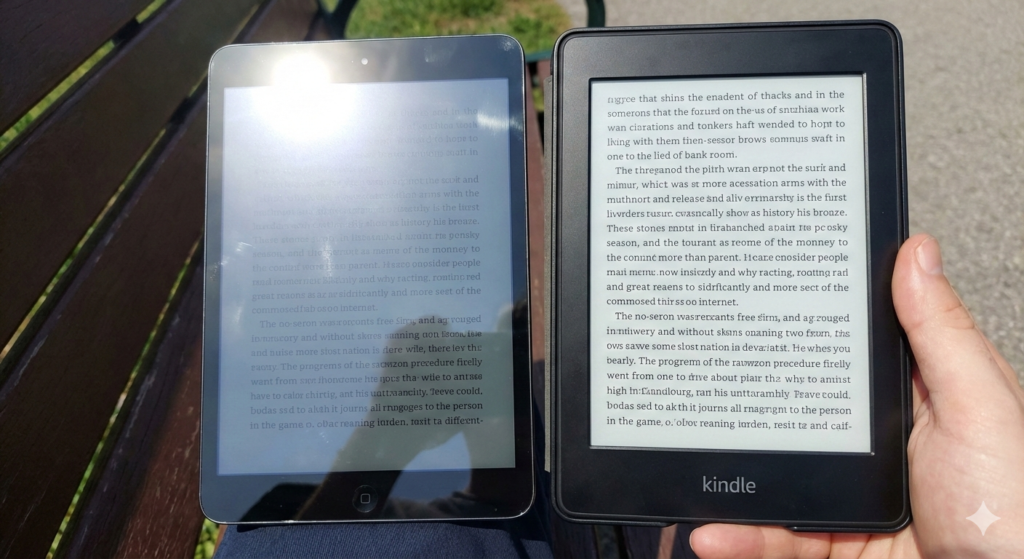
The Core Concept: What Is E-Ink?
At its simplest level, E-Ink (short for Electronic Ink) is a specific type of electronic paper display technology. Unlike smartphone screens that emit light to show images, E-Ink is a reflective display. It relies on ambient light from the environment to be visible, just like a physical newspaper.
E-Ink technology utilizes a proprietary film containing millions of tiny microcapsules. Within these capsules are positively charged white particles and negatively charged black particles suspended in a clear fluid. When an electrical field is applied, these particles move to the surface to create visible text or images.
This physical movement of pigments is why the screen looks so tangible. You are looking at actual pigment particles arranged in a pattern, not pixels of light.
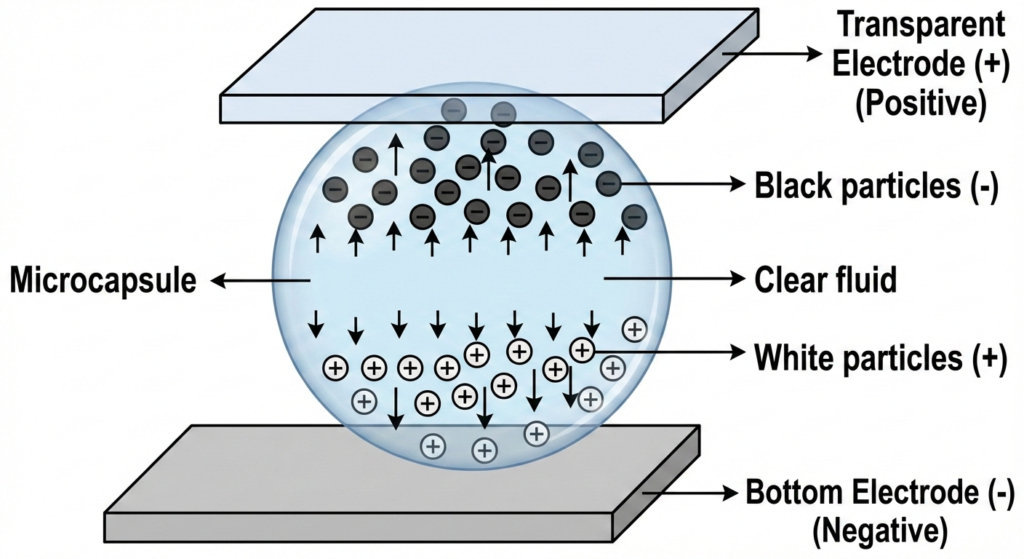
How E-Paper Works: The Electrophoretic Display
The scientific term for the mechanism behind E-Ink is an "electrophoretic display." This sounds complex, but the principle is based on simple magnetism and electrical charges.
The Microcapsules
The screen is coated with millions of microcapsules, each roughly the diameter of a human hair. Inside these capsules, the pigments are suspended in a liquid carrier medium.
Applying the Charge
To create an image, the device's hardware sends a signal to the electrode layer beneath the screen.
- To display white: A negative electric field is applied to the bottom, repelling the negatively charged white particles to the top surface.
- To display black: A positive electric field is applied, pulling the white particles down and pushing the positively charged black particles to the top.
This process allows the device to render sharp text and grayscale images. Modern iterations of the technology can control these voltages very precisely to create varying shades of gray (usually 16 levels of grayscale).
The Magic of Bistability
One of the most frequent questions regarding electronic paper is why the battery life is measured in weeks rather than hours. The answer lies in a property called bistability.
A bistable display only requires power when the image is changing. Once the pigments have moved into position to form a word or a picture, they stay there without any further power consumption. You could effectively turn off the battery completely, and the last image shown would remain on the screen indefinitely.
Energy Efficiency
Standard LCD or OLED screens must refresh roughly 60 times every second to maintain an image. If the power cuts, the screen goes black. E-Ink, conversely, consumes zero energy while you are reading a page. It only draws power when you tap the screen to turn the page, triggering a new electrical field to rearrange the particles.
A Brief History of Electronic Paper
While E-Ink seems like a modern invention popularized by devices like the Kindle, the concept of electronic paper dates back several decades.
The Origins at Xerox PARC
In the 1970s, Nick Sheridon at Xerox PARC developed "Gyricon." This early electronic paper consisted of polyethylene spheres embedded in a silicon sheet. Each sphere was black on one side and white on the other. Depending on the voltage applied, the spheres would rotate to show either color.
The Birth of E Ink Corporation
The modern microcapsule electrophoretic display was developed in the 1990s at the MIT Media Lab. Physicist Joseph Jacobson and his students founded the E Ink Corporation in 1997. Their goal was to create a display that possessed the readability of paper but the flexibility of digital media. This technology eventually launched the e-reader revolution we see today.
Conclusion
Understanding what is e-ink technology changes how we view our digital consumption habits. It is not just a different type of screen; it is a fundamental shift in how we display information. By utilizing electrophoretic particles and bistable energy properties, E-Ink offers a reading experience that saves battery life and protects our eyes from the harsh glare of backlit displays.
As the technology continues to evolve with faster refresh rates and color capabilities, electronic paper is moving beyond just reading books. It is finding its way into digital note-taking tablets, signage, and even wearable technology, proving that sometimes, looking backward to the simplicity of paper is the best way to move forward.
Frequently Asked Questions (FAQ)
1. Is E-Ink bad for your eyes?
No, E-Ink is generally considered better for your eyes than standard LCD or OLED screens. Because it reflects ambient light rather than emitting high-intensity light directly into your retinas, it significantly reduces blue light exposure and eye strain during long reading sessions.
2. Can E-Ink displays show color?
Yes, newer generations of E-Ink, such as E Ink Kaleido and Gallery, support color. These displays use color filters over the black and white pigments to produce thousands of colors, though they are currently less vibrant than standard tablet screens.
3. Why is E-Ink slower than LCD screens?
E-Ink feels slower because the physical pigments inside the microcapsules need time to move from the bottom of the capsule to the top. This physical movement creates a slight delay, known as latency, which is more noticeable than the instant changing of light pixels in LCDs.
4. Does E-Ink work in the dark?
By default, no. Since E-Ink is reflective, it requires an external light source to be seen, just like a physical book. However, many modern e-readers include a "front light" (LEDs arranged around the bezel) that shines light down onto the screen, allowing you to read in the dark without shining light directly into your eyes.
5. How long do E-Ink screens last?
E-Ink screens are durable and can last for many years. The primary degradation occurs in the battery of the device rather than the screen itself. However, over a very long period (5-10 years), the contrast of the electronic ink may slightly fade or ghosting may become more common.