Every year, millions of people hunt for the “perfect” physical planner. You might find one with a great daily layout, but it lacks a habit tracker. Or you find one with excellent weekly reviews, but the monthly calendar is too small. When you switch to a digital notebook, you are no longer bound by what printing companies decide to publish.
E-paper tablets allow you to import custom files, meaning you can design a productivity system tailored exactly to your brain. If you are ready to take control of your scheduling, this guide will walk you through creating digital planner templates, explaining the software required and how to structure a file that works seamlessly with your device.
The Core Concept: What Are E-Paper Templates?
Before designing, it is important to understand what the tablet actually requires to display a custom background.
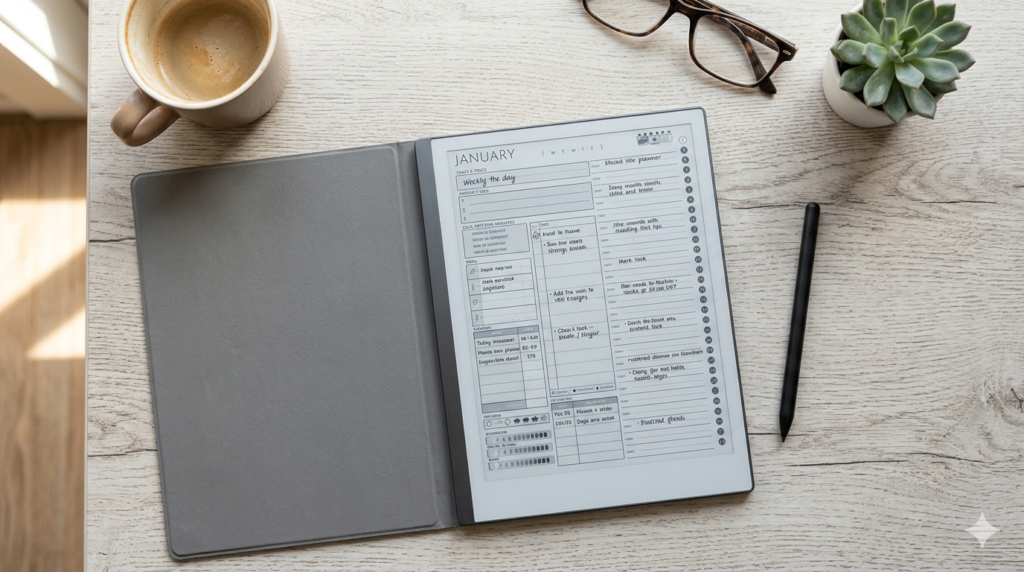
Creating digital planner templates involves designing custom page layouts—usually saved as a standard or hyperlinked PDF file—that can be imported into an e-paper tablet. These files act as a static background canvas, allowing users to write over the design with a stylus just like a physical notebook.
Unlike proprietary apps, a PDF is universally recognized by almost every digital note-taking device on the market, from the reMarkable 2 to the Onyx Boox series.
Understanding the Hyperlinked PDF Planner
The most advanced DIY planners do not just have custom graphics; they have functional navigation. This is achieved through a hyperlinked pdf planner.
When you open a PDF on your tablet, it recognizes internal links. If you draw a series of “tabs” along the right side of your document (e.g., Jan, Feb, Mar), you can program the PDF so that tapping the “Feb” tab instantly jumps the user to page 32.
This mimics the physical dividers in a binder. It turns a 400-page document into an easily navigable interface. Without hyperlinks, scrolling through a massive annual planner on an e-ink screen would be frustratingly slow due to the screen’s refresh rate.
Software for Designing Productivity Templates
You do not need to be a graphic designer to build a functional diy digital planner. Standard presentation software is actually the industry secret for creating these files.
- Apple Keynote / Microsoft PowerPoint: These are the most popular tools for planner creation. They have built-in “Master Slides” for repeating elements (like your background and tabs) and make adding internal document links incredibly simple.
- Canva: An excellent, user-friendly web app with pre-made shapes and grids. It is perfect for beginners, though managing hundreds of hyperlinks can be slightly more tedious than in Keynote.
- Adobe InDesign / Affinity Publisher: For professional creators. These desktop publishing apps offer precise grid snapping and automated date generation, but they have a steep learning curve.
Building Your DIY Digital Planner: Step-by-Step
If you are ready to build your own system, follow this general workflow to ensure your file works correctly on your device.
Step 1: Set Your Canvas Size
Look up the exact screen resolution of your specific tablet. For many standard 10.3-inch e-paper devices, setting your canvas to 1404 x 1872 pixels (or a standard A5 ratio) ensures your planner will fit the screen perfectly without ugly black borders.
Step 2: Design the Master Layout
Create a “Master Slide” that contains the elements that will appear on every single page. This usually includes:
- A faint dot grid or lined background.
- Your navigation tabs (Months, Weeks, Notes).
- Any permanent margins required by your device’s interface.
Step 3: Populate the Pages and Link
Duplicate your base pages and begin dating them. Once all pages exist, go back to your Master Slide and hyperlink the tabs to their respective sections.
Creating a fully dated, 365-day planner with weekly and monthly views requires thousands of individual hyperlinks. If this sounds too tedious, many users prefer to start with a foundational digital planner template pack and simply customize the cover and the blank note pages to save time while still getting a professional result.
The Digital Bullet Journal Approach
Not everyone needs a strictly dated, rigid planner. Many users prefer the digital bullet journal method.
Instead of designing 400 linked pages, you design a simple 10-page PDF containing various blank frameworks: a dot grid page, a blank monthly calendar grid, a habit tracker block, and a daily log block. You import this small file into your tablet and simply duplicate the specific pages you need as you go.
This approach offers maximum flexibility. You can add three daily pages if you have a busy Tuesday, and skip the weekend entirely without leaving blank pages in your file. For a broader look at organizing these individual files within your device’s folder system, refer to our comprehensive guide on Digital Note Taking Mastery: From Handwriting to The Cloud.
Conclusion
Creating your own productivity templates unlocks the true potential of your digital notebook. By understanding how to utilize presentation software and hyperlinked PDFs, you can construct an organizational tool that mirrors your exact thought process. Whether you build a complex daily planner from scratch or opt for a minimalist digital bullet journal, customizing your software environment ensures your tablet becomes a dedicated hub for focused output.
Frequently Asked Questions (FAQ)
1. What file format should my digital planner be?
Your final export must be a standard PDF file. E-paper tablets do not natively support Keynote (.key), PowerPoint (.pptx), or Adobe (.indd) files for handwriting. You must export the finished design as a PDF.
2. Why are my hyperlinks not working on my tablet?
On most e-paper tablets and note-taking apps, the stylus defaults to “writing mode.” If you tap a link with the pen tool active, it will just draw a dot. You usually need to switch to “Read Mode,” “Hand Tool,” or turn off the pen temporarily to activate the hyperlinks.
3. Can I use color in my digital planner templates?
Yes, but remember that most e-paper screens are monochrome (black and white). If you design a planner with light yellow boxes and light blue text, they may both render as the same shade of pale gray on the tablet. It is best to stick to high-contrast black, white, and dark gray when designing for standard e-ink.
4. Do these templates work on an iPad?
Yes. A hyperlinked PDF planner designed for an e-paper device will work perfectly on an iPad using apps like GoodNotes, Notability, or PDF Expert. The internal linking structure is universal.
5. How do I get the template onto my tablet?
You can transfer the PDF file to your tablet using the manufacturer’s companion desktop app, their cloud sync service, or by plugging the device directly into your computer via a USB-C cable and dragging the file into the “Documents” folder.