The average person checks their smartphone over 100 times a day. We reach for our devices in line at the grocery store, during lulls in conversation, and immediately upon waking up. This constant connectivity often leaves us feeling drained, scattered, and anxious without knowing exactly why.
If you are tired of the infinite scroll and want to reclaim your attention, you need a structured intervention. Willpower alone is rarely enough to beat algorithms designed to keep you hooked. This guide outlines a comprehensive 30-day challenge designed to break your autopilot habits, offering actionable digital minimalism challenge ideas to help you permanently reset your relationship with screens.
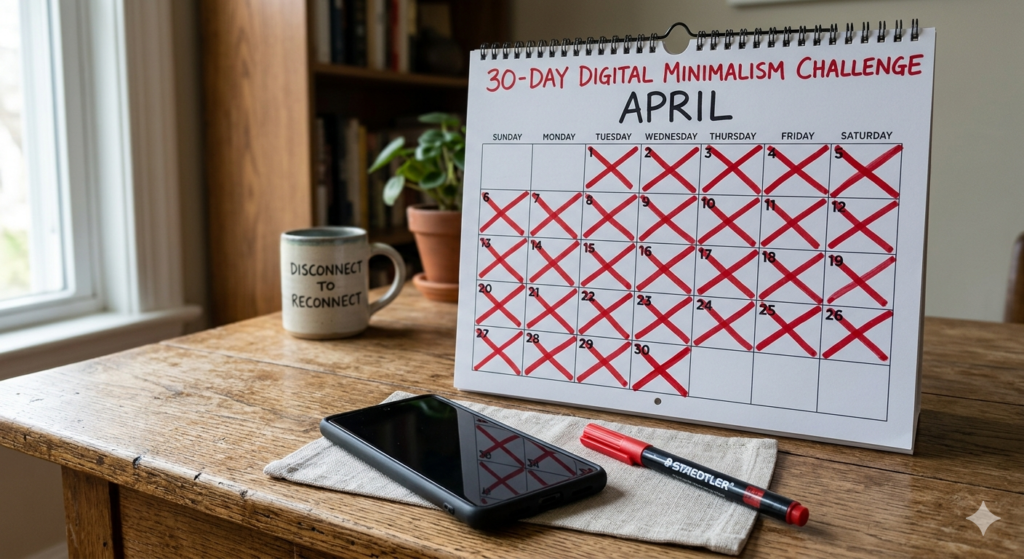
What is a Digital Minimalism Challenge?
Before starting, it is important to understand the objective of this month-long commitment.
A digital minimalism challenge is a structured, 30-day period where you intentionally restrict non-essential technology use to break the cycle of digital addiction. This tech detox helps reset your baseline focus, allowing you to reintroduce only the tools that add genuine value to your life.
It is not about throwing your devices into the ocean and moving to the woods. It is a calculated experiment to discover what you actually miss when the digital noise is turned off.
Week 1: The Social Media Detox and Baseline Reset
The first seven days are notoriously the hardest. Your brain is accustomed to receiving high-frequency, low-effort rewards from your phone.
To initiate a proper dopamine fast, you must remove the sources of immediate gratification. Start by deleting all social media apps, news aggregators, and non-essential video streaming services from your smartphone. You do not have to delete your accounts, but you must remove the apps from the device that is always in your pocket.
During this week, you will likely feel the phantom urge to check your pocket or tap where the app icon used to be. Acknowledge the urge, take a breath, and let it pass. This discomfort means the detox is working.
Week 2: Conquering the Attention Economy at Work
By the second week, the initial withdrawal symptoms usually subside. Now, it is time to tackle the technology you have to use: your work tools.
Many professionals suffer from digital burnout because they treat their email inbox like a chat room. Focus on screen time reduction during your 9-to-5 by implementing batch processing. Check your email only at 9:00 AM, 12:00 PM, and 4:00 PM. Keep your inbox closed outside of those windows.
To further protect your concentration during deep work sessions, remove your phone from your desk entirely. Using a physical analog timer to track your 45-minute work sprints is highly effective. It provides a visual countdown without requiring you to look at a screen that might tempt you with fresh notifications.

Week 3: Practicing Mindful Scrolling and Intentionality
Week three introduces the psychological component of the challenge. The goal is to move from forced restriction to conscious choice.
This phase is all about practicing mindful scrolling. If you need to look up a tutorial on YouTube or check a community board on your desktop, you must first define your intention. Say out loud, “I am opening this site to find a recipe for dinner.” Once you find it, close the tab.
This friction prevents you from falling down the algorithmic rabbit hole. For a deeper dive into the core philosophy driving these choices, read our foundational guide on Digital Minimalism Meaning: A Guide to Intentional Tech Use. Understanding the “why” will keep you motivated as the challenge progresses.

Week 4: The Reintroduction Phase
The final week is the most critical part of the 30-day challenge. It is time to decide which technologies get to return to your life, and under what conditions.
Do not simply reinstall everything. Instead, establish strict operating procedures for the tools you missed. Here are some effective rules for the reintroduction phase:
- Desktop Only: Only allow social media use on a desktop computer, never on a mobile device.
- The Bedroom Ban: Purchase a standard alarm clock and commit to charging your phone in the kitchen overnight.
- Curated Feeds: Unfollow any account that does not provide educational value, inspiration, or a genuine personal connection.
By forcing technology to pass a strict value test, you regain control over your digital environment.
Conclusion
Completing a 30-day digital minimalism challenge is not about proving how tough you are; it is about discovering how much time you actually have. By stepping away from the constant hum of the attention economy, you give your brain the space it needs to think deeply, rest fully, and engage meaningfully with the physical world.
As you conclude the 30 days, remember that the goal is not to hate technology. The goal is to ensure that you are using your digital tools, rather than allowing your digital tools to use you.
Frequently Asked Questions (FAQ)
1. What if my job requires me to use social media?
If you manage social media for work, treat it strictly as a professional tool. Use scheduling software (like Buffer or Hootsuite) to post content without ever opening the actual platform’s feed. Never log into work accounts on your personal devices.
2. Will I experience withdrawal symptoms during a dopamine fast?
Yes, it is very common. In the first few days, you may experience restlessness, irritability, and a feeling of “missing out” (FOMO). This is a normal neurochemical response as your brain adjusts to a lower level of constant stimulation. It usually passes after day four or five.
3. What should I do with my newly found free time?
You must have high-quality analog activities ready to fill the void. Buy a physical book, start a jigsaw puzzle, exercise, or take up a tactile hobby like cooking or sketching. If you do not plan analog activities, you will simply stare at the wall and eventually relapse into screen use out of boredom.
4. Can I watch TV or movies during the 30-day challenge?
This depends on your personal rules, but standard digital minimalism allows for intentional viewing. Watching a specific, two-hour movie with your family on a Friday night is intentional. Mindlessly flipping through Netflix menus for 45 minutes by yourself is not.
5. Do I need to buy a “dumbphone” to succeed?
No. While swapping your smartphone for a basic flip phone is an effective strategy for some, it is not strictly necessary. Deleting problematic apps, turning off all non-human push notifications, and utilizing your phone’s built-in grayscale mode can turn a modern smartphone into a highly functional, non-addictive tool.