The modern workplace is an obstacle course of constant interruptions. Between instant messaging channels, email notifications, and the endless temptation of open browser tabs, sitting down to focus on a single complex task feels almost impossible. For many professionals, the primary barrier to high-quality output is not a lack of skill, but a lack of uninterrupted attention.
If you struggle to maintain concentration, you might be relying too heavily on willpower rather than modifying your environment. This guide will explore practical tips for deep work, specifically focusing on how intentionally downgrading your technology—such as adopting E-Ink devices—can force your brain into a highly productive flow state.
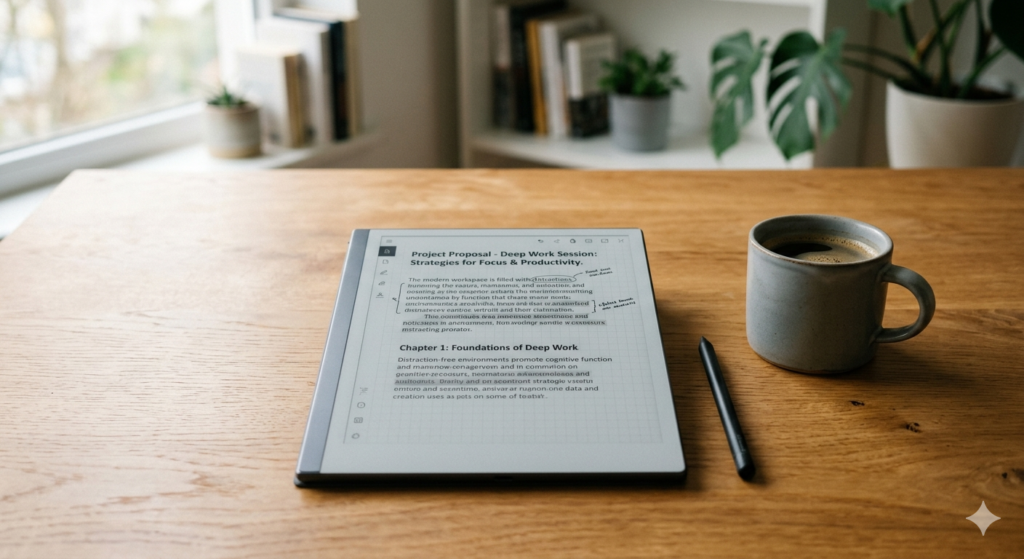
Understanding Deep Work and Flow State
Before we can optimize our tools, we must define the goal.
Deep work is the ability to focus without distraction on a cognitively demanding task. These tips for deep work involve structuring your environment and tools to eliminate interruptions, allowing you to enter a “flow state” where productivity, creativity, and quality of output reach their absolute peak.
When you successfully block out the noise, your brain stops wasting energy on context switching. This leads to profound cognitive load reduction, allowing you to solve complex problems much faster than you could in a fragmented, distracted environment.
Why Your Laptop Sabotages Single Tasking
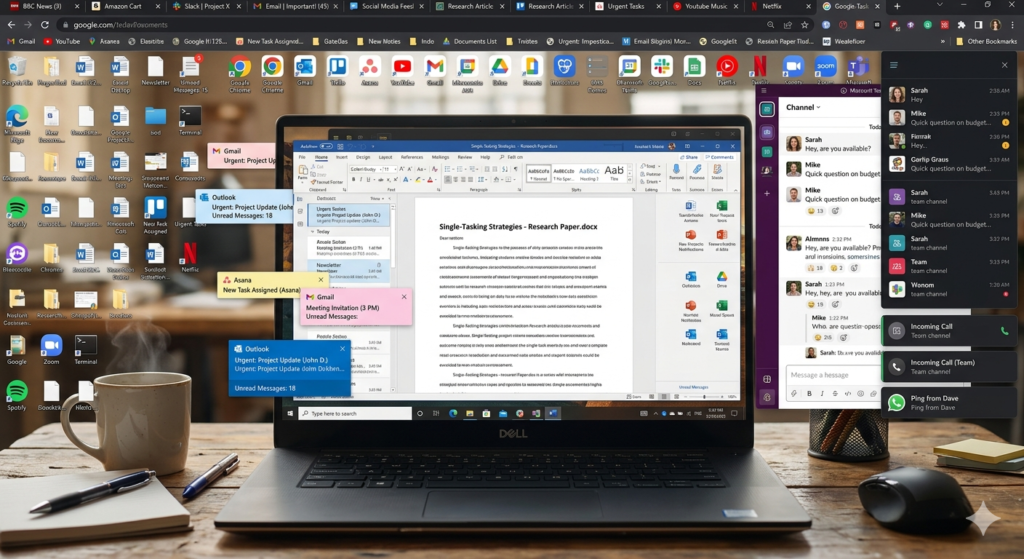
Standard computers are designed to do everything at once. While this flexibility is great for general administrative tasks, it is catastrophic for deep concentration.
The temptation of the internet is always just one click away. Even if you try to practice single tasking on a laptop, a simple pop-up notification can derail your train of thought. Regaining that lost focus can take upwards of 20 minutes.
To combat this, many professionals adopt the philosophy we outlined in our guide on Digital Minimalism Meaning: A Guide to Intentional Tech Use. By actively removing capabilities from our environment, we protect our attention span.
Leveraging Hardware Limits for Distraction-Free Writing
This is where E-Ink technology becomes a powerful productivity tool. E-Ink tablets (like the reMarkable, Supernote, or Kindle Scribe) are inherently limited by their hardware.
Because the screens have a slow refresh rate and lack color, they are terrible for watching YouTube, scrolling social media, or rapidly browsing the web. These limitations are actually the device’s greatest feature. They force a physical environment of distraction free writing.
When you sit down with an electronic paper device, you can only do one thing: write or read. By removing the physical ability to distract yourself, you eliminate the need to use willpower. The hardware dictates the focus.
Setting Up Environmental Flow State Triggers
While an E-Ink tablet handles the visual distractions, you also need to manage your physical environment. The brain responds well to routines and sensory cues, known as flow state triggers.
To quickly enter a state of deep concentration, you should create a specific ritual. For example, clearing your desk of all papers before starting, or brewing a specific type of tea.
Auditory triggers are equally important. Putting on a pair of high-quality noise cancelling headphones and playing a familiar, lyric-free track can act as a psychological switch. Over time, your brain will associate the physical act of putting them on with the immediate need to focus, drastically reducing the time it takes to enter the zone.
Conclusion
Mastering your attention in a hyper-connected world requires more than just trying harder; it requires strategic constraints. By applying these tips for deep work, you can construct an environment where focus is the default state rather than a constant struggle.
Whether you achieve this by utilizing the hardware limitations of an E-Ink tablet or by establishing strong physical routines, the result is the same. You will produce higher quality work in less time, leaving you with more mental energy at the end of the day.
Frequently Asked Questions (FAQ)
1. How long should a deep work session last?
For beginners, a deep work session should last about 45 to 60 minutes. As you train your attention span, you can extend this to 90 or 120 minutes. Pushing beyond two hours without a break usually results in diminishing returns due to mental fatigue.
2. Can I do deep work while listening to music?
Yes, but the type of music matters. Lyrical music forces your brain’s language processing centers to work in the background, which can cause cognitive strain while reading or writing. Ambient music, classical music, or binaural beats are generally recommended.
3. What is the difference between deep work and a flow state?
Deep work is the action or practice of focusing without distraction. A flow state is the psychological result of that practice—a feeling of being completely immersed and energized by the task at hand, where time seems to slip away.
4. How do I handle urgent communications during deep work?
Communication is key. If you are part of a team, establish “focus hours” and communicate them clearly. Set your status to “Do Not Disturb” and provide a channel (like a specific phone number) that is only to be used for genuine emergencies.
5. Is E-Ink truly distraction-free?
While modern E-Ink tablets running Android can technically download apps like email or web browsers, the slow, black-and-white screen makes using them tedious. This inherent friction is usually enough to deter mindless scrolling, making them highly effective for distraction-free work.